Electrician SEO: What Your Jobsite Photos Prove
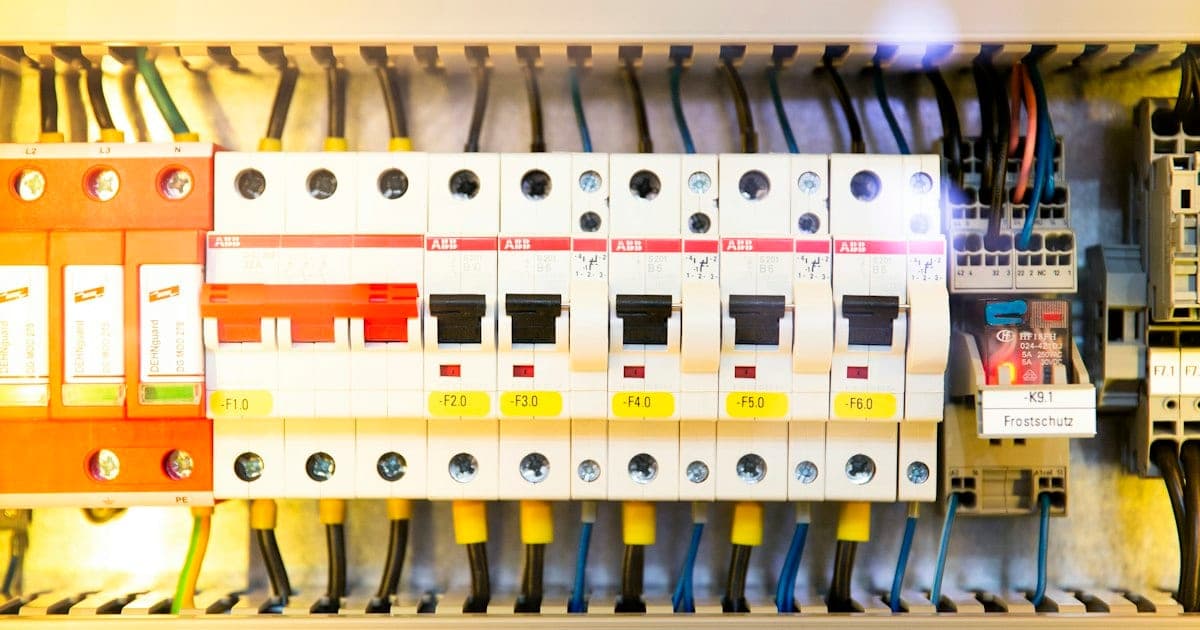
Most advice filed under electrician SEO is the same generic checklist you have read three times already: claim the profile, collect reviews, build citations. The part nobody writes about is the one asset your business produces that an agency cannot: the photographs you take on every job. A consumer unit shot before you start and again when you finish already carries the time it was taken and the coordinates of the address you were standing at, written inside the image file.
That pairing is a record: this work, at this address, on this date. What follows is what your photos already hold, how to check it, how to repair it when it is missing, and which popular ranking claim a controlled study has since contradicted.
What a jobsite photo already records
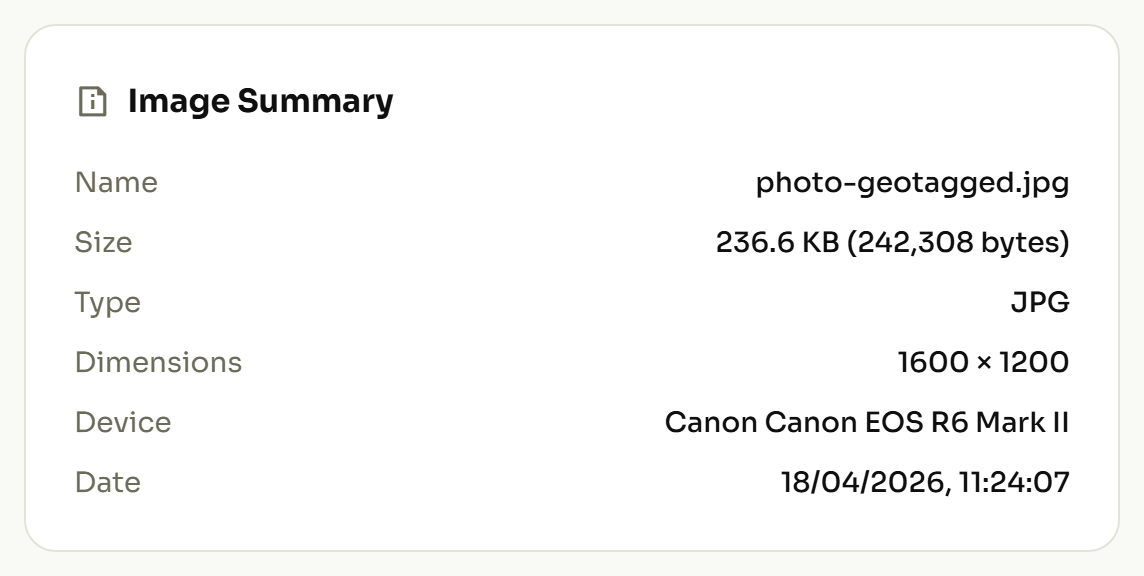
Every photo from your last job has two parts: the picture, and a block of information the camera wrote alongside it. Phone cameras fill that block in without being asked. It is where the date lives and, if location was switched on, where the coordinates live.
Four entries in that block do the work for a contractor. Each has a name you can go and look for in your own files.
| Named entry | What it holds | Why it matters on a job |
|---|---|---|
DateTimeOriginal |
The moment the shutter fired, on the local clock your phone was set to | This is the "when" in "when did we do this work". It records the original exposure, not the day someone later copied or re-saved the file |
OffsetTimeOriginal |
Which time zone that clock reading belongs to | Without it, "14:30" is just a number on a screen. With it the time is unambiguous, which is exactly what you need when a job is questioned a year later |
GPSLatitude and GPSLongitude |
Where the phone was standing when you pressed the button | The address as the phone measured it, rather than as somebody typed it from memory afterwards |
GPSHPositioningError |
How far out the phone believed its own fix might be | Tells you whether to trust the coordinate. A fix taken in a basement plant room is not the same quality as one taken on the driveway |
Those names are not ours; they are the standard names every camera and photo tool uses, listed in the ExifTool tag reference and its GPS section. You need nothing installed to look at your own: read the GPS block straight out of a photo and see which of the four your phone actually filled in.
The two clocks inside every jobsite photo
A located photo carries two independent time records, and the relationship between them is what makes it worth something as evidence.
The first is your phone's local clock, stored in DateTimeOriginal. The second comes from the satellites: GPSDateStamp and GPSTimeStamp are written in UTC, the global reference time, because UTC is what a GPS fix broadcasts. The ExifTool GPS reference describes that stamp plainly as the UTC time of the GPS fix.
A genuine file therefore agrees with itself. Take the local time, apply the zone recorded in OffsetTimeOriginal, and you land on the UTC time the GPS wrote independently. A photo taken at 21:30 in a zone seven hours behind UTC converts to 04:30 the next day, which is why the GPS date on a late call-out can legitimately read as tomorrow's date and nothing is wrong.
Two things follow for a contractor. A file whose two clocks disagree has been edited, re-saved or had its date altered by hand, and you want to discover that before you send it to a customer or an insurer. A file whose GPS block is simply empty is not suspicious at all. It means location was off when you shot it, which is the ordinary state of a phone in a metal-clad riser.
A real coordinate, written out
A mapping app hands you a location as two decimal numbers. That is not the form the photo stores, and the gap between the two is where jobsite locations quietly go wrong.
Take a point anyone can check: Battersea Power Station in London, published at 51.48167, -0.14472. The file splits each number into degrees, minutes and seconds.
- 51.48167 gives 51 whole degrees.
- The remaining 0.48167, multiplied by 60, is 28.9, so 28 minutes.
- That remaining 0.9, multiplied by 60, is roughly 54 seconds.
The latitude is stored as 51 degrees, 28 minutes, 54 seconds. The published position for the same building reads 51°28′54″N, which is the check that the arithmetic landed correctly.
The longitude is the one that catches people out. Minus 0.14472 works out to 0 degrees, 8 minutes and about 41 seconds, but the file never stores the minus sign at all. The "west of Greenwich" half of that number lives in a separate entry called GPSLongitudeRef, which holds one letter: W.
Lose that single letter and the job moves to the far side of the prime meridian. The same trick applies to latitude, where a missing N sends the address into the southern hemisphere.
Does geotagging move your local rank?
No, and this is the claim worth retiring, because the older guides for this trade are built on it.
The belief is that uploading geotagged photos to a Google Business Profile tells Google where you operate and lifts your local ranking. It was finally tested. Jake Hundley of Evergrow Marketing ran a 10-week controlled study across 27 businesses, reported in Search Engine Land in March 2025: five weeks with location data stripped from the images, then five weeks with coordinates added for targeted towns.
Of seven metrics tracked, exactly one improved: "near me" queries in the areas that had been tagged. Four of the remaining six got worse. His summary was that it "hurts everywhere you don't add geotagged images", and that his agency would not geotag client images.
Google's published photo requirements for a Business Profile point the same way. They specify the accepted formats, a file size between 10 KB and 5 MB, and a recommended 720 by 720 pixels, and say nothing at all about location data or metadata. The one requirement they do state is that "the image should represent reality."
So a located photo is not a ranking lever. Its value is the record itself, which is a slower and considerably more useful thing to own.
Where electrician SEO advice gets photos wrong
Three mistakes repeat across the vertical guides written for this trade, including several still in circulation from 2022.
- Treating a photo as an upload rather than a record. Every guide says to add photos of your work. None says what the file contains or what happens to it afterwards.
- Assuming Google reads the location out of the picture. The published photo requirements never mention it, and the controlled study found no general ranking benefit.
- Selling the tactic without ever testing it. Pages dated 2022 still assert that adding tags to images improves search performance greatly. There is no measurement behind that sentence, and the measurement that now exists disagrees with it.
What survives all three is narrower and sturdier: a photograph that can state where and when, on demand, long after everyone involved has forgotten the job.
A two-minute jobsite photo routine
None of this replaces the electrician SEO basics, and it is not meant to. It is the part that costs two minutes on site and that nobody else on your street is bothering with.
- Switch location on for the camera before you start. Everything below is easier when the phone fills the coordinates in for you.
- Shoot the board before you touch it, wide enough to catch something that identifies the property.
- Shoot the finished work from the same standing position, so both files carry the same coordinate.
- Check one photo from the job before you pack up. If the location block is empty, you find out now rather than in six months.
- For any photo that came back without a position, write the coordinates into the file yourself while you still remember which property it was.
- File the pair under the address, not the date. The date is already inside the file; the address is what you will search for.

For the mechanics rather than the routine, the full walkthrough for geotagging photos covers it start to finish, and the location-tagged photo pages built per trade show the same workflow applied in other fields.
Related reading
Two more on the same problem, from a different trade.