Yoga Studio SEO: A Small, Local Photo Workflow
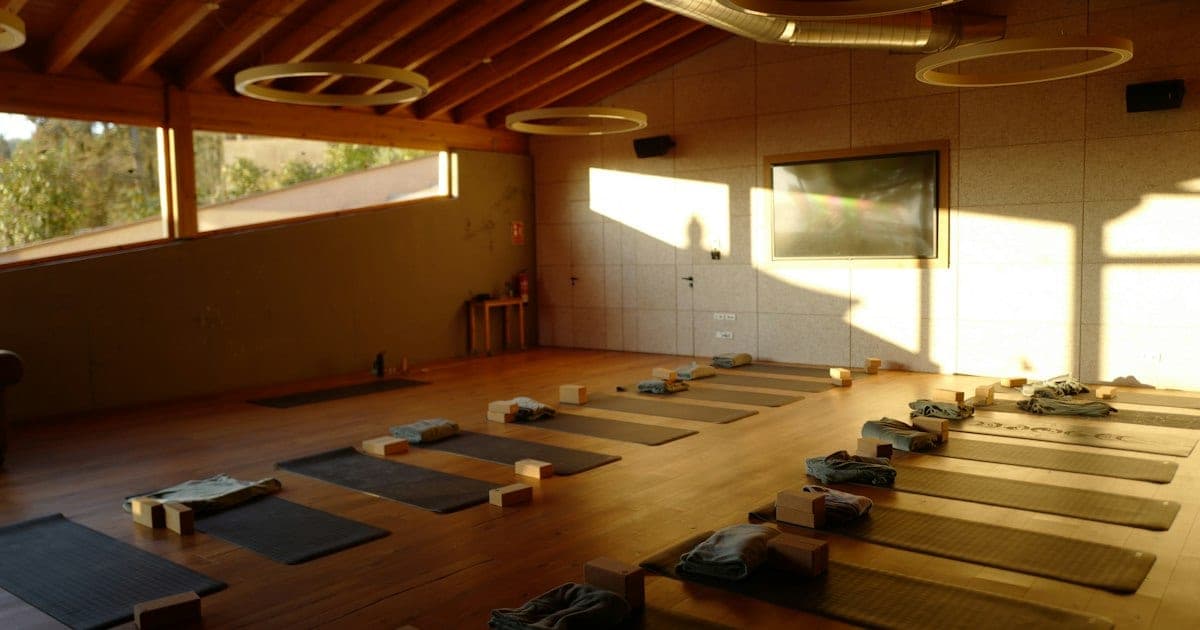
Yoga studio SEO is a smaller problem than the guides make it look, because a studio is one address. You are not tracking work across fifty properties or cataloguing venues across a county. You have one room, or two, photographed continuously: classes, workshops, teacher trainings, the new floor, the wall someone finally painted. And the same coordinate applies to nearly every file you will ever own.
That simplicity is the whole opportunity. Decide the studio's position once, apply it consistently, and the rest is a short routine. What follows is that routine, plus the one timing quirk that catches early-morning classes, and an honest answer about rankings.
One address, photographed a thousand times
A studio's photo library grows from many hands. You shoot some of it; teachers send you class photos from their own phones; a photographer comes in once a year for the good ones; someone's student posts a picture you would like to reuse.
Those files arrive in wildly different states. A phone with location switched on records a position automatically. A phone with it switched off records none. An image that has passed through a messaging app or a social platform on its way to you has usually lost whatever it had, because re-encoding an image tends to discard the information attached to it.
So the practical starting point is not "add coordinates to everything". It is to find out what you are holding. Open a handful of recent class photos and look at what each one actually recorded. You will typically find three groups: correct, absent, and wrong.

The coordinate you write once
For a single-site studio there is exactly one position worth agreeing on, and it is not the middle of the building. Use the point a person would walk to: the street door.
Write it down once, to five decimal places, and keep it somewhere your teachers can copy it from. Five decimal places puts you inside about a metre, which is far finer than anything you need and costs nothing to store.
Two details make the difference between a coordinate that works everywhere and one that quietly breaks. The file never stores a minus sign: a position west of Greenwich or south of the equator keeps its direction in a separate one-letter entry, GPSLongitudeRef holding W, or GPSLatitudeRef holding S. That's what the published GPS field reference sets out. Copy a coordinate by hand and drop the letter, and the studio moves hemisphere.
The second is consistency. One agreed position used on every photo makes the whole library sortable. Five slightly different positions, each picked by whoever happened to be editing that day, makes it noise.
Why a 5am class photo can carry yesterday's date
This is the quirk worth knowing, and it bites early-morning studios specifically.
A photograph keeps two separate time records. One is your local clock, stored as DateTimeOriginal with its time zone kept alongside it in OffsetTimeOriginal, both set out in the published field reference. The other comes from the satellites, and those stamps are recorded in UTC, the global reference time, rather than in your local time.
For most of the day those agree on what day it is. For a dawn class they may not. Take a studio running five and a half hours ahead of UTC and a 5:00 am class: subtract the offset and the satellites record 23:30 on the previous day.
So the photo's local date says the 14th while its GPS date says the 13th, and both are correct.
The consequence is practical. Any tool that sorts your library by the GPS date rather than the local one will file every early class on the day before it happened. If your morning photos keep landing in the wrong folder, this is why, and nothing is corrupted.
Does geotagging lift a studio's local rank?
No. The claim that geotagged photos uploaded to a Google Business Profile tell Google where your studio is and improve your local position has been tested, and it did not hold up.
Jake Hundley of Evergrow Marketing ran a 10-week controlled study across 27 businesses, reported in Search Engine Land in March 2025: five weeks with location data stripped from images, then five with coordinates added for targeted areas. Of seven metrics tracked, one improved. Four of the remaining six got worse.
Google's own photo requirements for a Business Profile agree by omission. They specify formats, a file size between 10 KB and 5 MB, and a recommended 720 by 720 pixels, and mention location data nowhere at all.
Older guides in this niche promise otherwise, and several of them still carry a year in the title that has long since passed. Treat the promise the way you would treat the date.
A yoga studio SEO routine for one location
- Agree the street-door coordinate once and store it where your teachers can copy it.
- Collect class photos into one folder per month, whatever state they arrive in.
- Check a sample for position and date before you do anything else.
- Select everything that is missing a position and write the studio's coordinate across the whole set in one pass.
- Leave photos taken somewhere else alone: a retreat, a park session, a teacher's own studio. A wrong location is worse than none.
- For anything going public where you would rather not publish an exact position, remove it deliberately instead of assuming the upload will.
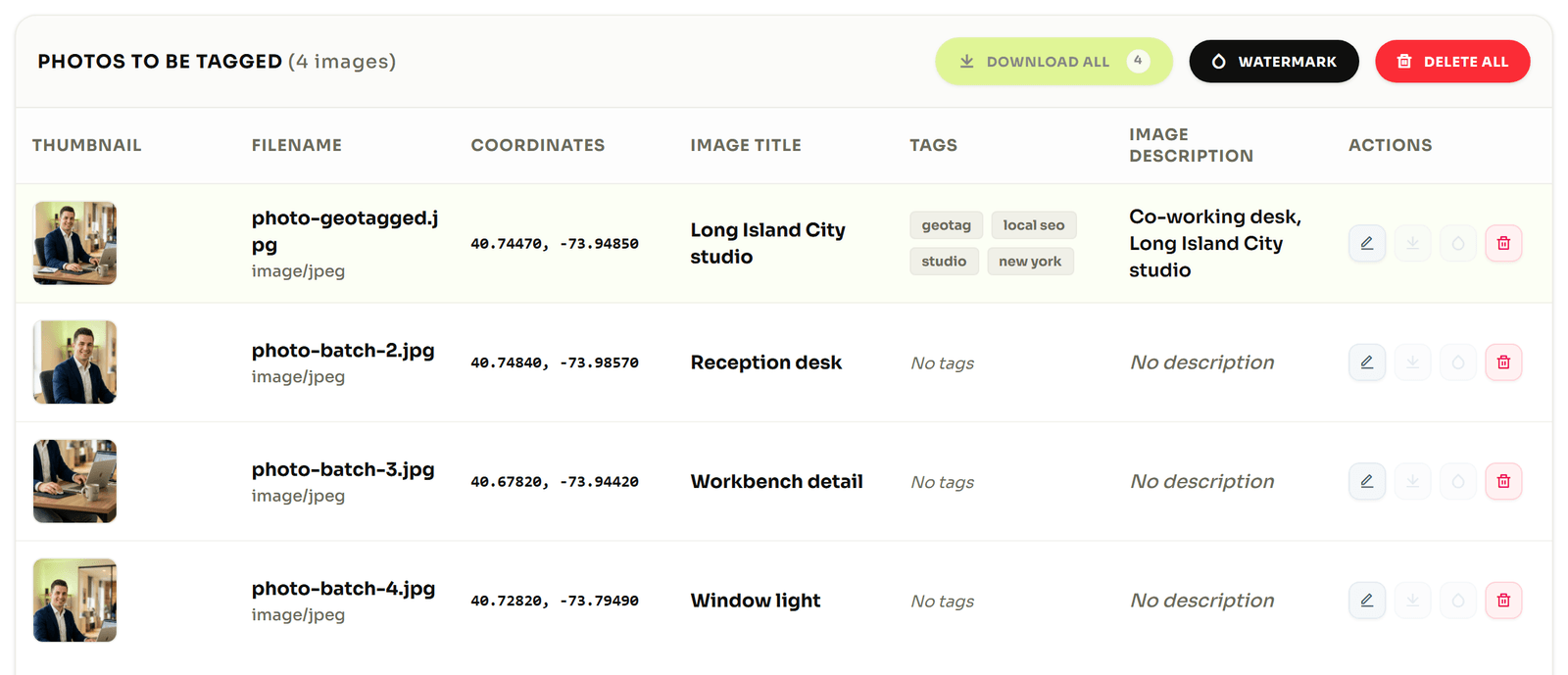
That is the whole workflow. It takes longer to read than to run once a month, and it produces a library that stays sorted without a spreadsheet.
If you would rather work from a desktop, geotagging a photo on a computer covers that route, and taking the location back out of a picture covers step six in detail.