Fitness SEO: What Your Gym's Interior Photos Record
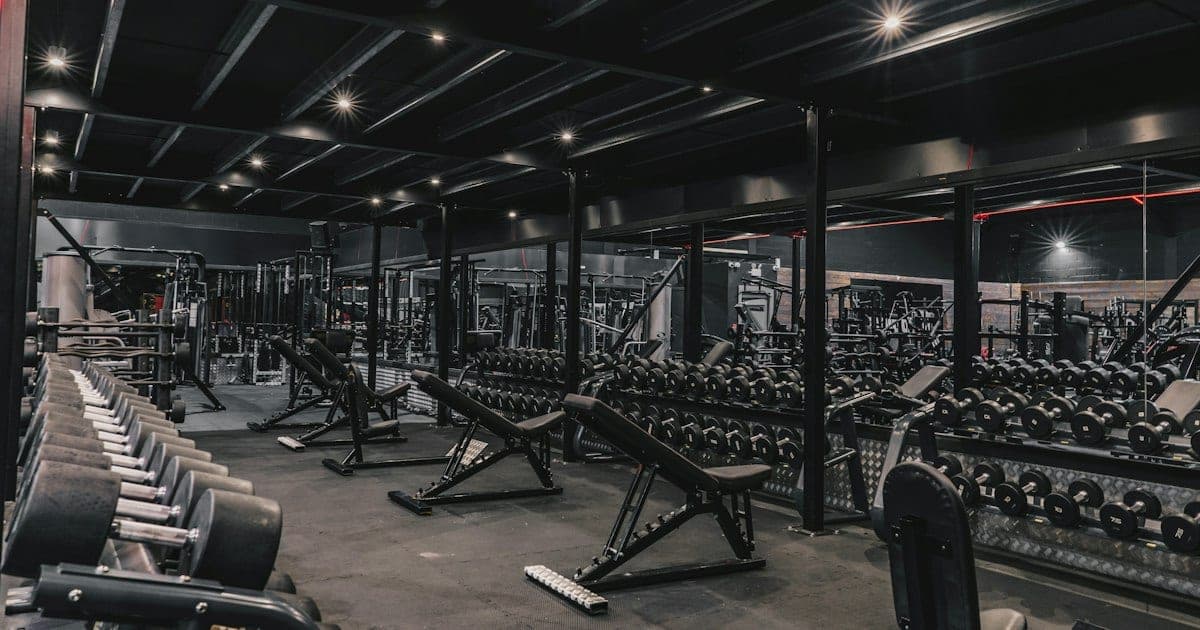
Most of what passes for fitness SEO advice about photographs amounts to "upload pictures of your gym". The part worth knowing is narrower and less flattering: your photos are almost all interiors, and an interior photo behaves differently from one taken outside. The position it records may not have come from a satellite at all, and no amount of tagging it will move you up the local results.
This is a short article because the honest version of this topic is short. Here is what an indoor photo records, how to tell where its location came from, and what the evidence says about geotagging and rankings.
What a photo taken indoors actually records
A phone photographed outdoors gets its position from satellites, and the result is usually good to within a few metres. Inside a building with a steel frame, a low ceiling and no view of the sky, that is not what happens.
The phone still gives you a position, because it falls back on other sources: the Wi-Fi networks it can see, or the cell towers it is connected to. The photograph is saved with coordinates either way, and nothing in the picture tells you which method produced them. A shot from the middle of your studio floor and a shot from the pavement outside can differ by more than the length of the building.
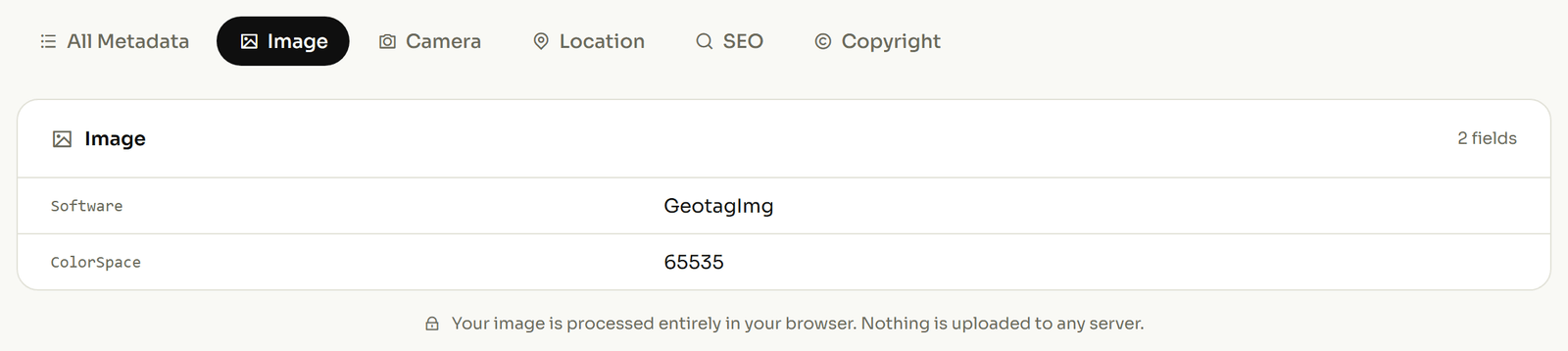
That is not a defect to fix. It is a property to know about before you build anything on the assumption that a gym photo knows precisely where it was taken. Take any photo from your own camera roll and read the position it stored, and you can see which of your rooms produce sensible answers.
How a photo says where its position came from
Photographs have a field for exactly this question, and it is the most useful thing in this article. It is called GPSProcessingMethod, and the published GPS field reference lists the values it is meant to hold.
| Recorded value | What it means | What to do with it |
|---|---|---|
GPS |
The position came from satellites | Trust it. Almost always a shot taken outside, or by a window |
WLAN |
The position was worked out from nearby Wi-Fi networks | The normal result deep inside a building. Close enough to identify the block, not the room |
CELLID |
The position came from the mobile network | The roughest of the three. Treat it as "somewhere in this neighbourhood" |
MANUAL |
Somebody typed the position in | Accurate if the person was careful, and honest about being a human decision rather than a measurement |
A companion field, GPSHPositioningError, records how far out the phone itself believed the fix might be. Between the two you can tell a satellite fix on the forecourt from a Wi-Fi guess in the weights room, which is more than you could tell from looking at the pictures.
Does geotagging help a gym rank?
No. This is the one claim in the older fitness marketing posts that deserves to be retired, and it has now been tested rather than asserted.
Jake Hundley of Evergrow Marketing ran a 10-week controlled study across 27 businesses, reported in Search Engine Land in March 2025. Five weeks ran with location data stripped from the images; five ran with coordinates added for targeted towns. Of seven metrics tracked, one improved and four of the remaining six got worse. His conclusion was that the tactic "hurts everywhere you don't add geotagged images".
Google's published photo requirements for a Business Profile are consistent with that. They cover accepted formats, a file size between 10 KB and 5 MB, and a recommended 720 by 720 pixels. Location data is not mentioned anywhere on the page. The requirement that is stated is that "the image should represent reality".
The honest limits of fitness SEO for photos
Putting those two things together gives a boundary worth stating plainly, because this vertical has less to gain here than most.
A gym is one address. You are not a contractor documenting work at fifty properties, or a planner cataloguing venues across a county. You have one location, and your photos are mostly of rooms inside it. The filing problem that makes location fields valuable to other trades barely exists for you. You already know where every photo was taken.
What remains genuinely useful is narrower: knowing whether a photo's position is a measurement or a guess, being able to strip a position before publishing if you would rather not broadcast a precise indoor fix, and being able to set one clean, correct position on photos that arrived with none. Those are real, and they are the whole list. Anyone promising more than that from photo metadata for a single-site gym is selling something.
A ten-minute audit of the photos you already have
- Pick six photos: two from inside, two from the entrance, two taken outdoors.
- Read the position block on each and note where the fix came from. Expect the indoor ones to differ from the outdoor ones.
- Check whether any indoor shot has landed somewhere embarrassing: a neighbouring unit, or the road.
- For anything you plan to publish that has no position or a wrong one, set the position by hand to your actual front door.
- If you would rather publish with no location at all, remove it deliberately rather than hoping the upload strips it.
For the underlying mechanics, what geotagging actually writes into a photo covers the fields themselves, and pulling the location back out of a photo covers reading them in bulk.