SEO for Florists: Keep Your Name on Your Photos
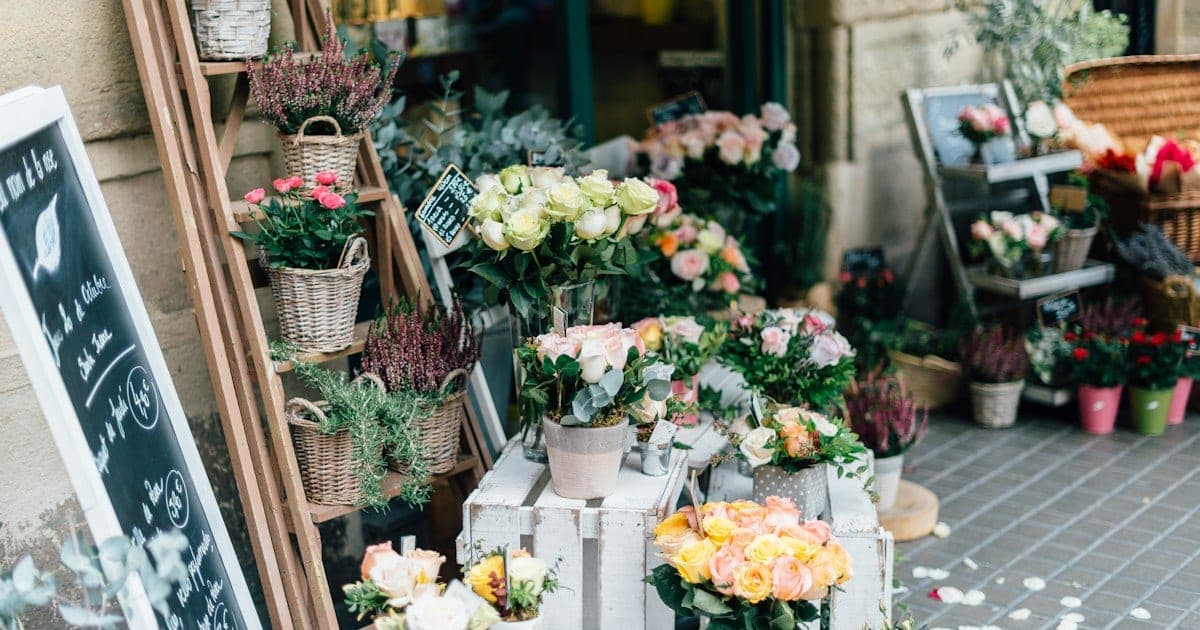
SEO for florists is a harder proposition than the standard checklist admits, because a flower shop is rarely competing only with the flower shop down the road. It is competing with national delivery brands, with the wire services that route orders into local shops, and with Google Business Profile, which answers a lot of floral searches without sending anyone to a website at all. Keyword research does not change that shape. What you own outright, and what none of those competitors can reproduce, is a photograph of an arrangement you actually made.
This article is about that photograph: what to put inside it, what survives when it travels, and which field you should deliberately leave blank.
Why seo for florists is harder than the checklists admit
Start with the honest description of the market. Teleflora's own recruitment page for florists describes its network as "the industry's largest, with more shops to send and receive your orders", and states that "we are now the only major floral service that channels 100% of all orders to local florists" (Teleflora).
Read that as a description of where the customer's attention lands. In the wire-service model, the search ends at the intermediary and your shop fulfils an order it was never found for. You did the work, the brand got the search, and none of your on-page effort was involved in either.
Meanwhile the local results that remain are decided by what Google says decides them: relevance, distance and prominence (Google Business Profile help). Distance you cannot change. Prominence is slow. Relevance is the only one a blog post touches, and it is the one with the most competition per unit of effort.
That is not an argument for giving up on being found. It is an argument for being clear-eyed about which of your assets is scarce. It is not your keyword list.
The one asset a marketplace cannot copy
A national brand can outspend you on ads and outrank you on a generic phrase. It cannot photograph the arrangement you built on Tuesday, because it did not build it.
Floral design is original creative work, and photographs of it travel further than almost any other trade's. Couples repost them, venues put them on their own galleries, planners use them in pitch decks, and wedding blogs pick them up years later.
So your best image ends up in front of exactly the audience you want, usually with somebody else's caption on it and no way back to you.
That is the actual leak, and it is not a keyword problem. A photograph circulating without your name is a marketing asset working for someone else. Before you change anything, it is worth taking one of your own published images and checking what it still carries: you can check which of those details a photo still carries in a browser, and the answer for most shop photos is nothing at all.
Putting your name inside the photograph
Photographs can carry their own attribution, written into the file rather than typed onto the page around it. This is the part worth understanding, because Google is explicit about the difference: information embedded in the image "only needs to be added once per image", since it stays with the file wherever it goes, whereas markup on a page has to be repeated on every page the image appears on (Google Search Central).
Four things are worth filling in, and each answers a question a stranger looking at your photograph would have:
- Who made this? The
Creatorfield: your name or the studio's. This is the one that survives longest and does the most work. - Who should be credited? The
Creditline: what a publication prints beneath the image when it uses it. Give them the exact wording you want and they will usually use it. - Who owns it? The
CopyrightNotice: a short statement of ownership, up to 128 characters, which is more than enough for a name and a year. - Where are the terms? The Web Statement of Rights: a link to a page on your site explaining how the image may be used. Google states you must include this field for an image to be eligible to be shown with its licensable badge, so it is the one with a direct, documented consequence.
None of this requires a photographer or a contract. It takes a minute per image the first time and can be applied to a batch afterwards. When your next set of arrangement photos comes off the camera, write your credit and copyright into the file before anything gets posted, and the attribution travels with every copy that leaves your hands intact.
Where embedded credit survives and where it does not
Honesty matters more than enthusiasm here, because this technique has real limits and overselling it would leave you trusting something that is not there.
The IPTC photo metadata working group has tested platform behaviour across several rounds, covering roughly a dozen services in its Spring 2019 test. An earlier round across fifteen social platforms found only one of them retained and displayed embedded information well, and that ten removed at least some of it when an image was downloaded.
The mechanism behind the failures is mundane: when a service resizes your image, the embedded block goes with it. So the credit you wrote survives on your own website, in files people download directly, and in the places Google reads rights information from. It frequently does not survive a repost through a social platform that re-encodes.
That still leaves embedding worth doing. It costs a minute, and it is the only version of attribution that travels without you. The alternative, nothing in the file at all, guarantees the outcome you already have. Just do not treat it as a watermark, and keep publishing under your own name where you control the page.
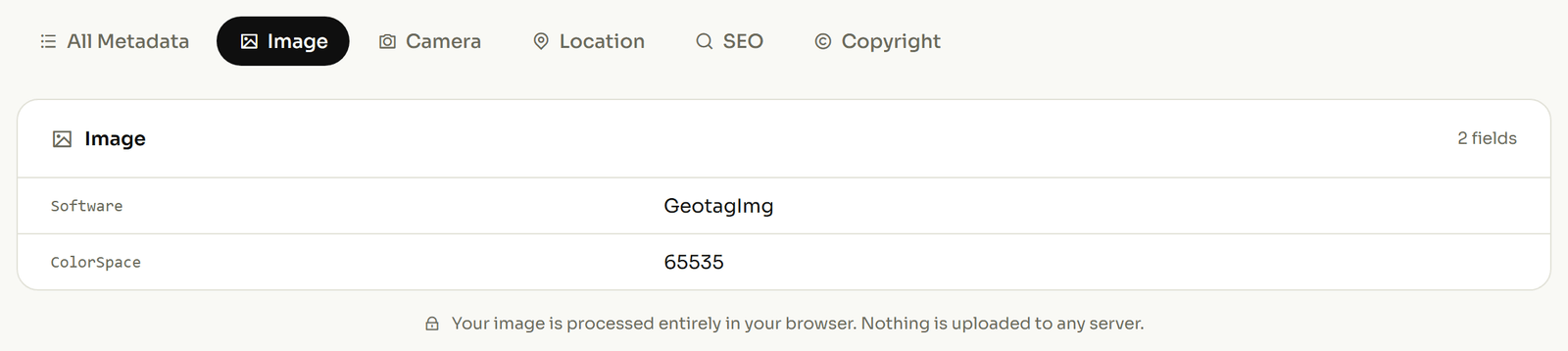
The location field is the one to leave empty
Here the advice for florists diverges sharply from the advice for every other trade, and the checklists have never noticed.
Arrangement photographs are taken in private homes, at wedding venues, and on the doorsteps of recipients. A coordinate written into a delivery photo is somebody's home address, attached to a picture you are about to publish. For a builder documenting a site that is the entire point; for a florist it is a disclosure nobody asked you to make.
The counter-argument has always been that geotagging lifts local rankings. That was tested in a 10-week controlled study across 27 businesses published in March 2025: of seven metrics, one improved and four got worse, and the agency that ran it stopped geotagging client images. So the trade-off is a privacy cost against a benefit that did not hold up.
Photograph in the shop where you can. Where you cannot, check what the camera recorded and take the location back out of a photo before it goes anywhere near your gallery.
A photo routine for a week of arrangements
Short enough to survive a Valentine's week, which is the only test that matters.
- Shoot finished arrangements in the shop against a consistent background, with location switched off on the camera.
- Once a week, put your creator name, credit line and copyright notice on the whole batch in one pass.
- Add a plain description of what the arrangement is, including the flowers and the occasion, so the file is searchable to you later.
- Publish from your own site first, so the original with your details in it is the version that exists.
- Keep the untouched originals in one folder and treat every reposted copy as beyond your control.
Step one is the one people skip, and it is the one with a consequence. If you are unsure whether your camera has been recording locations all along, what one messaging platform does to a photo's location is a useful illustration of how unpredictable this gets once a file starts moving between apps.